Estrangement: We’re Asking the Wrong Question
Heart 180 calls for a shift in the national conversation about therapists vs family estrangement.
A recent Wall Street Journal feature asking whether therapists are to blame for the rise in adult children cutting off their parents has set off weeks of debate: therapists defending their profession, researchers publishing new numbers, commentators taking sides. A survey cited in the coverage, of 7,000 estranged parents, found that a third believe a therapist influenced their adult child's decision to cut contact, one of the numbers fueling the argument.
We've been watching this conversation closely at Heart 180, because it's the conversation we live in every single day. And we think it's asking the wrong question.
Blame doesn't heal anyone
Whatever combination of factors is behind any one estrangement — a therapist's guidance, a pattern of harm that finally got named, a wound that never healed, a culture that's given people new language for old pain — the estrangement is already here. It exists, and it’s running rampant. Trying to assign the blame exclusively to therapists, parents, adult children, social media, or cultural changes may generate debate, but it will not heal a single family.
And this is not a fringe issue. A survey led by Cornell sociologist Karl Pillemer found that 27% of American adults were estranged from a close relative, including 10% from a parent or child. A more recent national poll put the number even higher, with 38% of U.S. adults currently estranged from a sibling, parent, child, or grandparent.
Therapy culture is one thread in that story, but only one, alongside social media, generational conflict, evolving ideas about what counts as harmful, and, in some families, real and serious abuse. No single villain explains numbers like these. That's exactly why blame is a dead end: the problem was never simple enough for one cause, so it won't be solved by finding one.
Here's the better question
If estrangement is this widespread and this tangled, the more useful question isn't "who did this?" It's: who is teaching people a safe way back?
Who is offering a steady, supportive voice to someone standing in the deep end of the pain pool of estrangement? Who is walking with the adult child who already made that call and is quietly wondering, years later, whether it was right, without being pushed toward an answer either way? Who is standing with the parent who's been shut out, wants to do the work, and doesn't know where to start?
That question is largely missing from this conversation. It's the one we exist to answer.
And to be clear, this is not a parents-versus-adult-children debate. Thousands of people have shared their estrangement stories with us, and the pain crosses every kind of family relationship: parents and children, grandparents and grandchildren, siblings, and others. Estrangement exists across all of them, and the pain is deeply felt on every side.
One decision, an entire family affected
A decision to go no-contact is never felt by only one person. It reshapes grandparents' lives, siblings' loyalties, holidays, and the stories that get passed down to the next generation. Everyone in that family system carries part of the weight, whether or not they were the one who made the call.
When someone is cut off by a loved one, they are not simply frozen in time, untouched by the separation. Real damage continues to occur. Trust erodes, wounds deepen, and grief compounds.
Mourning someone who is still alive, but has chosen not to have anything to do with you, is a very real, painful, and frightening emotional journey. Real, sustainable reconciliation asks something of everyone in that system, not just the person who walked away.
Reconciliation takes everyone to be willing
Reconciliation was never something one person could accomplish alone. Scripture says it plainly, in the closing words of the Old Testament: "And he shall turn the heart of the fathers to the children, and the heart of the children to their fathers" (Malachi 4:6, KJV). Notice the direction runs both ways. Both hearts have to turn.
It's the same pattern at the center of our faith. God didn't wait for humanity to fix itself before reaching out; He initiated reconciliation at the highest possible cost, sending His Son to die so the relationship could be restored, and He still asks for a response. That's the model we point families toward: reconciliation that is costly, initiated in love, and asks something real of everyone it touches. It isn't cheap, and it isn't automatic. It takes willingness, time, and — in our experience — a great deal of grace, on every side of the table.
What this is not
Two things we want to be direct about.
This is not an anti-therapist statement. Many therapists do careful, difficult work helping people set healthy boundaries, name real harm, and sometimes recognize that distance in a relationship is genuinely necessary for their safety. We're not interested in relitigating one profession's role in a much larger cultural shift.
And this is not a "reconcile at all costs" statement. Some relationships involve real abuse, addiction, or danger. In those situations, safety comes first, full stop. In those cases, choosing to create distance may be the wise and healthy path forward. Nothing here is meant to pressure anyone back into a relationship that could put them at risk.
What we're describing is narrower than either extreme, and we think more useful: a supported, faith-filled path for the individuals who do want to find their way back to each other. One that asks something of everyone involved, takes the original pain seriously, and trusts that the grace of God can do what blame never will.
Where Heart 180 fits in
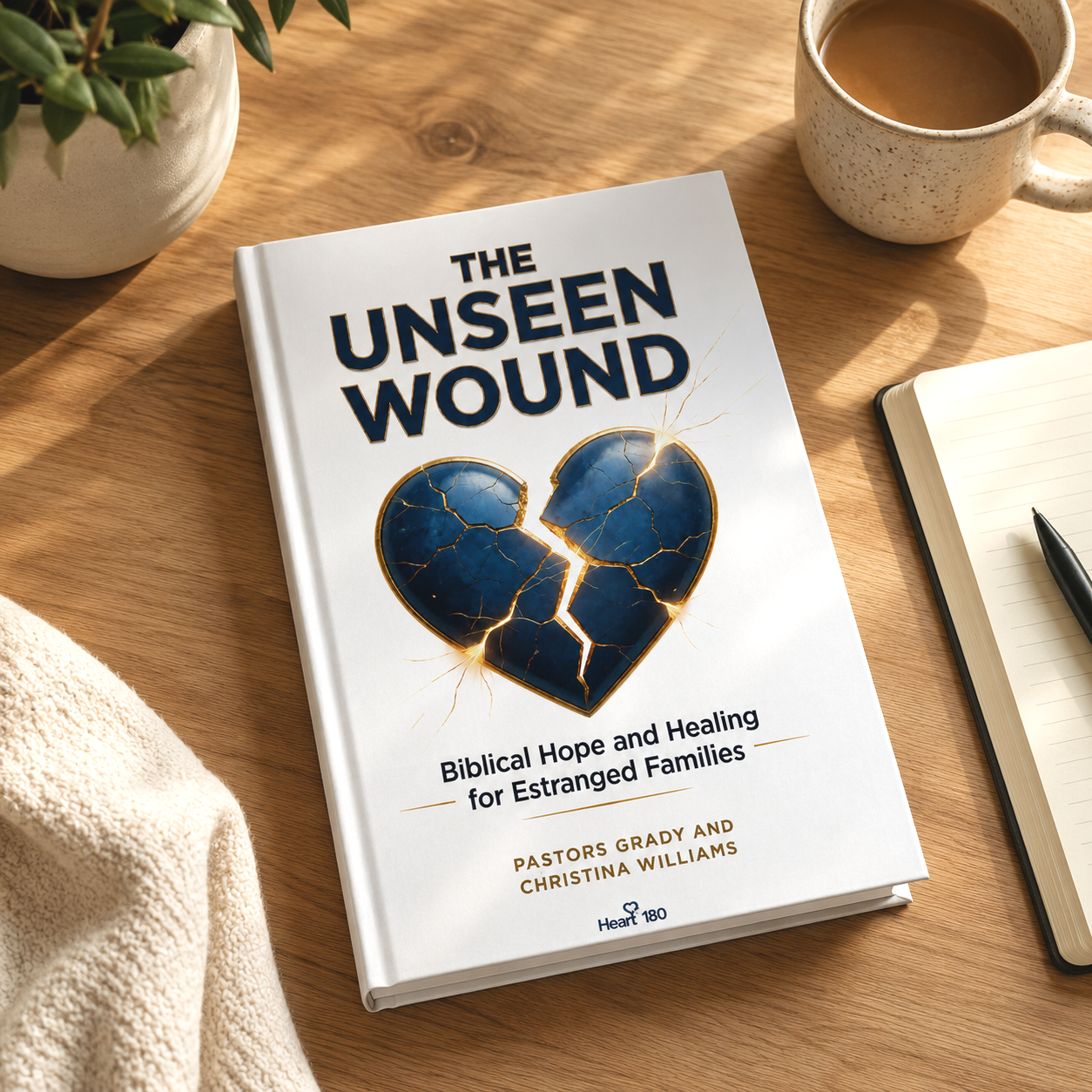
This is the work in front of us. Every week, through our Faith Filled Fridays prayer calls, the virtual Heart 180 Community we've built, and now our book, The Unseen Wound, we walk alongside parents, adult children, and families standing in the gap between estrangement and restoration. We don't offer a quick fix, but a supported journey toward healing and restoration, no matter which side of the estrangement fence someone is standing on.
"Long before Heart 180 existed, we walked through our own family's estrangement. While our story is still unfolding, we have seen God's faithfulness and have found hope in Him even in the midst of the pain," said Pastors Grady and Christina Williams, founders of Heart 180. "We're not offering easy answers or a formula. We're offering a biblical path to hope and healing, and we believe no family is too broken for God to work in."
If you're wondering whether a decision you made, or one that was made about you, has to be the end of the story, we don't believe it does. The Great Author is still writing your story. If you're not even sure where to start, that's exactly what we're here to help with.